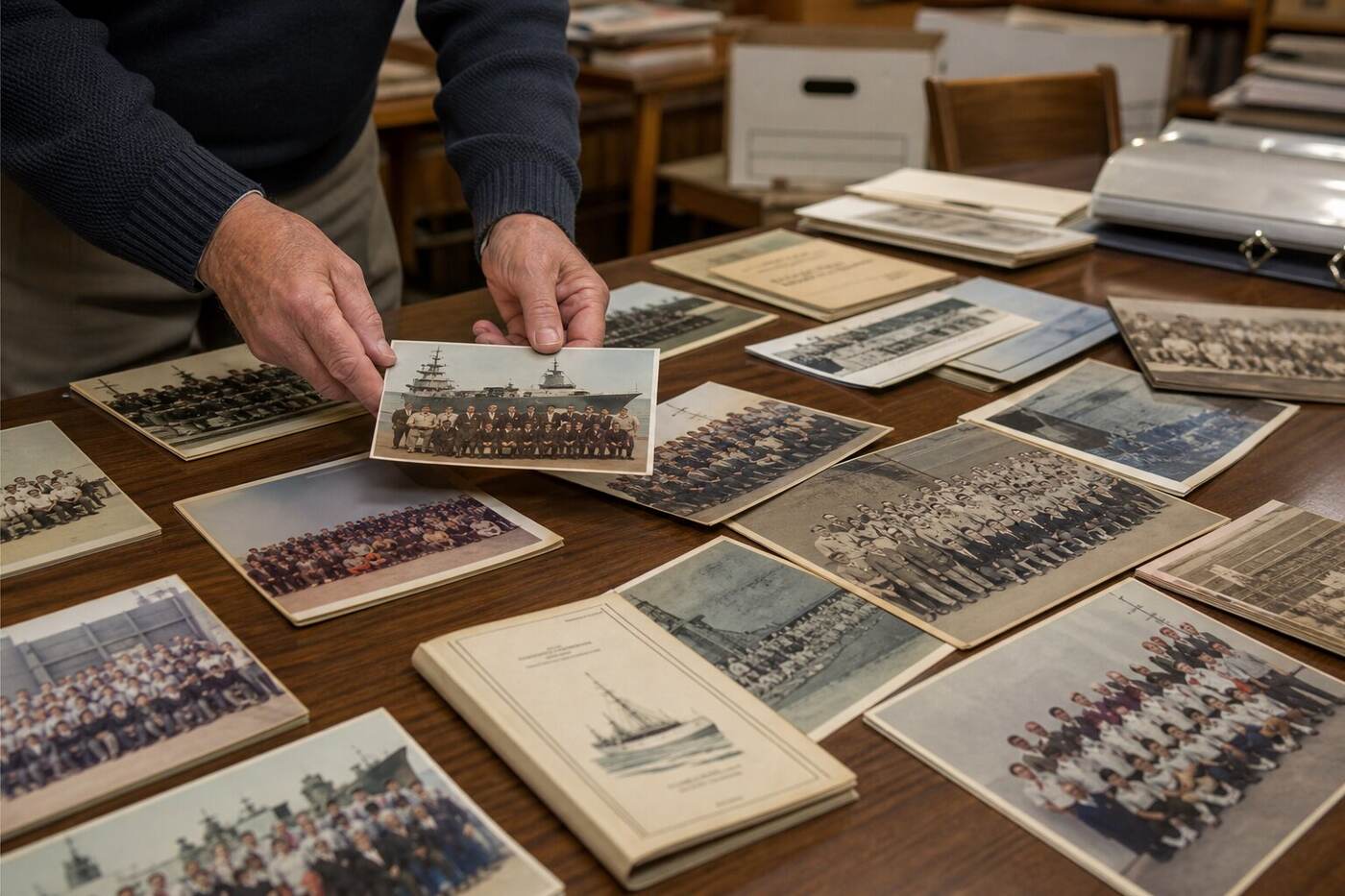
A reunion is an archive of relation
Dates, place names, group photographs and announcements can show how a ship community continued after service. They belong to social history even when they are not evidence for the ship’s wartime chronology.
Keep contact details out
Old pages often mix public announcements with personal email addresses or phone numbers. A responsible restoration preserves the route and topic while redirecting private directories to a broader memory and preservation page.
Make the archive findable
Use a clear title, date and provenance note. If permission for photographs is unclear, describe the kind of material that existed and link to the archive record rather than reproducing the image.
A reunion documents the afterlife of service
A reunion announcement or group photograph is not part of the ship's operational log, but it records how a community continued to organize around shared service. Dates, venues, programs and public newsletters can show the rhythm of that community when their sources and permission status are retained.
The historical route names a 2007 reunion, while related archived paths refer to planning and earlier gatherings. Those pages provide a taxonomy of community memory. They do not justify republishing old email addresses, telephone numbers or participant lists that were assembled for a limited audience years ago.
Reunion calendars rarely stand alone. Crew associations have long attached themselves to the civic dates a town already keeps, which is why a veterans' section so often appears in a hometown Independence Day column; a local magazine that documents how a York County parade is organised, block by block shows the same record types a ship archive needs, namely a dated programme, a published route and a named organiser. Reading a civic parade file next to a reunion file makes it easier to see which parts of a gathering were public from the start.
Separate the public program from private contact
A public invitation, commemorative program or permission-cleared group image can be described and preserved. A contact directory should be redirected to a broader memory page rather than recreated. This preserves the historical subject and the value of inbound links without turning obsolete personal data into a new public resource.
Names may be necessary when they identify a speaker, donor or public caption, but the reason should be visible. A page does not become more credible merely by listing more people. The useful record explains who created the item, when it circulated and how it contributes to the history of the ship's community.
Reunion material can guide new research
A program may name a presentation, a photograph may carry an annotation and a newsletter may point to a personal collection. Each is a lead. The next step is to contact the rights holder, preserve the item and compare its claims with official records where the subject overlaps with service history.
The archive should also record what is no longer available. A missing album or broken link can be noted without inventing its contents. By keeping route, date and provenance together, the journal makes future contributions easier to place and avoids repeating the loss of context that affected many early personal websites.
Research worksheet
Put this method to work
A reunion collection can preserve a public program, newsletter, permission-cleared group photograph and oral-history recording without republishing its registration list. Give every event a date, place, organizer record and source note, then connect materials through identifiers. This produces a useful social archive while allowing contact details and sensitive correspondence to remain closed. The public page explains the event; the archive retains the evidence under appropriate access.
Continue the research
Follow the evidence into the next question
Personal accounts from gatherings should use the oral-history checklist.
Group photographs belong in the responsible crew archive only with captions and permission.
For vanished files, follow the preservation route and record what is known.
Use the dia children and books route.
Use the cours et ateliers du centre culturel route.