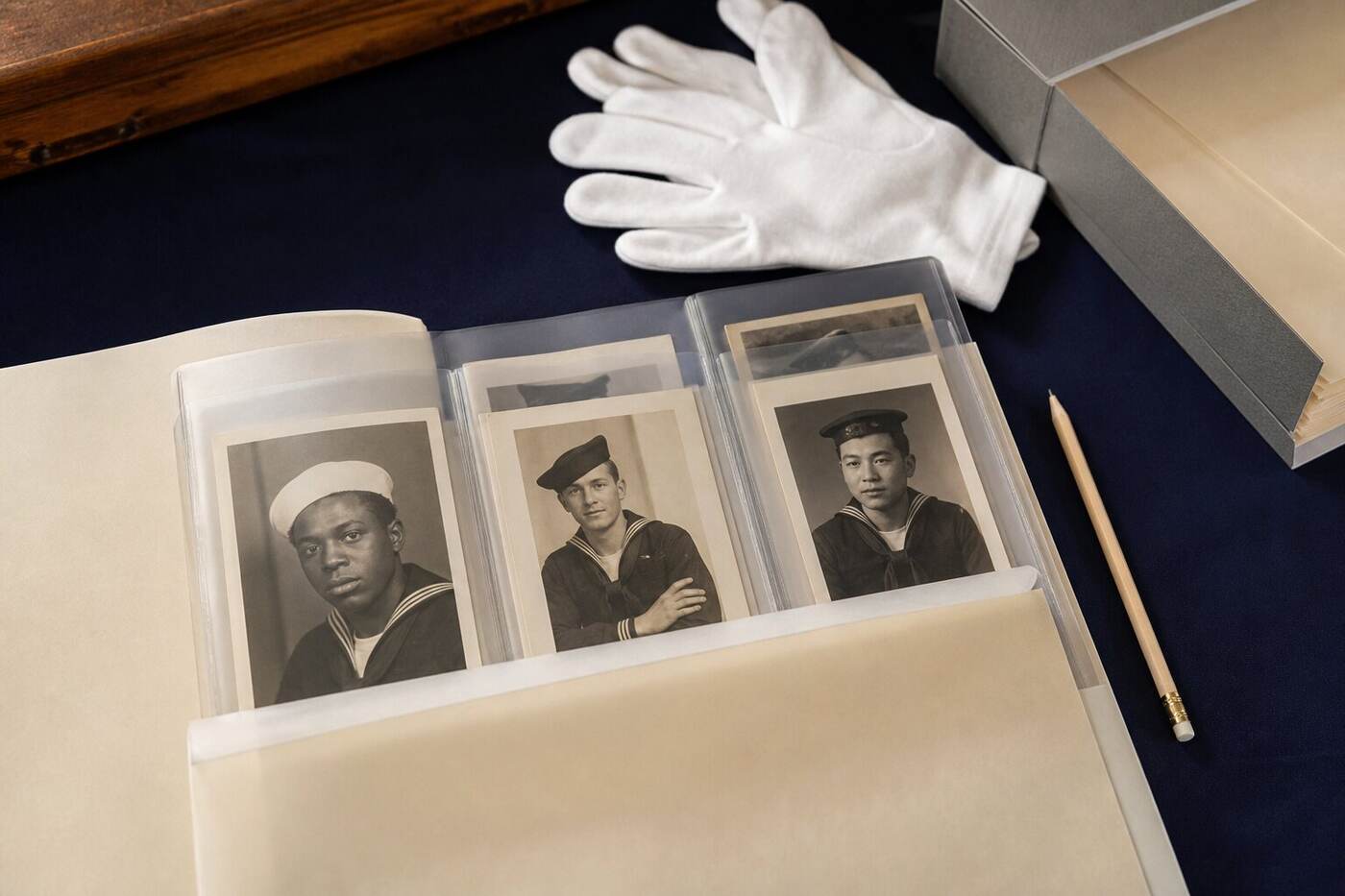
Preserve the original context
Keep the scan filename, owner note, back of the photograph and the date it entered the archive. A cropped image without its context can be visually attractive and historically thin.
Names require a reason
A public archive should not become a roster by accident. Include a person’s name only when it is necessary to identify the item, supported by a source and appropriate to publish.
Permission is part of metadata
Photographs from a former website, family collection or repository each have a different rights path. Record that path before republication and use locally generated explanatory images when the status is unresolved.
Preservation files and publication files differ
Create a high-resolution preservation scan before cropping, sharpening or color correction. Keep the reverse of the print, album page and any handwritten caption. A smaller publication derivative can then be produced without replacing the master. The archive should record which file is the master and which changes were made to the copy.
Use stable filenames that do not rely on an uncertain identity. A neutral identifier such as collection, box and sequence is safer than assigning a person's name before the caption has been checked. Names and descriptive keywords can live in metadata and be corrected without renaming every derivative.
Identify people with graduated confidence
A family caption, reunion annotation and later facial comparison do not carry equal weight. Preserve the exact source of each identification and use terms such as identified, attributed or unknown. Avoid turning a tentative social-media comment into a permanent public label simply because several copies repeat it.
Muster rolls can establish that a person was assigned to a ship during a period, but they do not prove that the person appears in a particular photograph. Uniform details, companions, location and the print's custody may add support. The archive should show the reasoning rather than only the final name.
Permission belongs beside the caption
Ownership of a physical print, copyright in the photograph and permission from a depicted living person are related but separate questions. Record what is known for each image. If publication rights remain unclear, preserve the description and research note while keeping the scan out of the public gallery.
The old crew-picture route is restored as a guide instead of a copied gallery. That protects private material and still preserves the route's purpose. A future image can be added when the archive has a stable source, a useful caption, a rights decision and a reason it contributes to the ship's history.
Research worksheet
Put this method to work
A minimal image record contains archive identifier, physical format, approximate date, creator if known, donor or holder, supplied caption, editorial description, people identifications with confidence, rights status and derivative filenames. None of these fields needs to be perfect before preservation begins. The important point is to keep uncertainty explicit and avoid baking a guess into the only copy. Public display follows after the record, not before it.
Continue the research
Follow the evidence into the next question
Use the photo provenance chain to connect scans, captions and repositories.
For visual ship clues, follow the identification worksheet.
Community images from later years belong beside the reunion archive method.
Open the baptist history in state records route.
Return to the treviso to trebaseleghe transfer route.