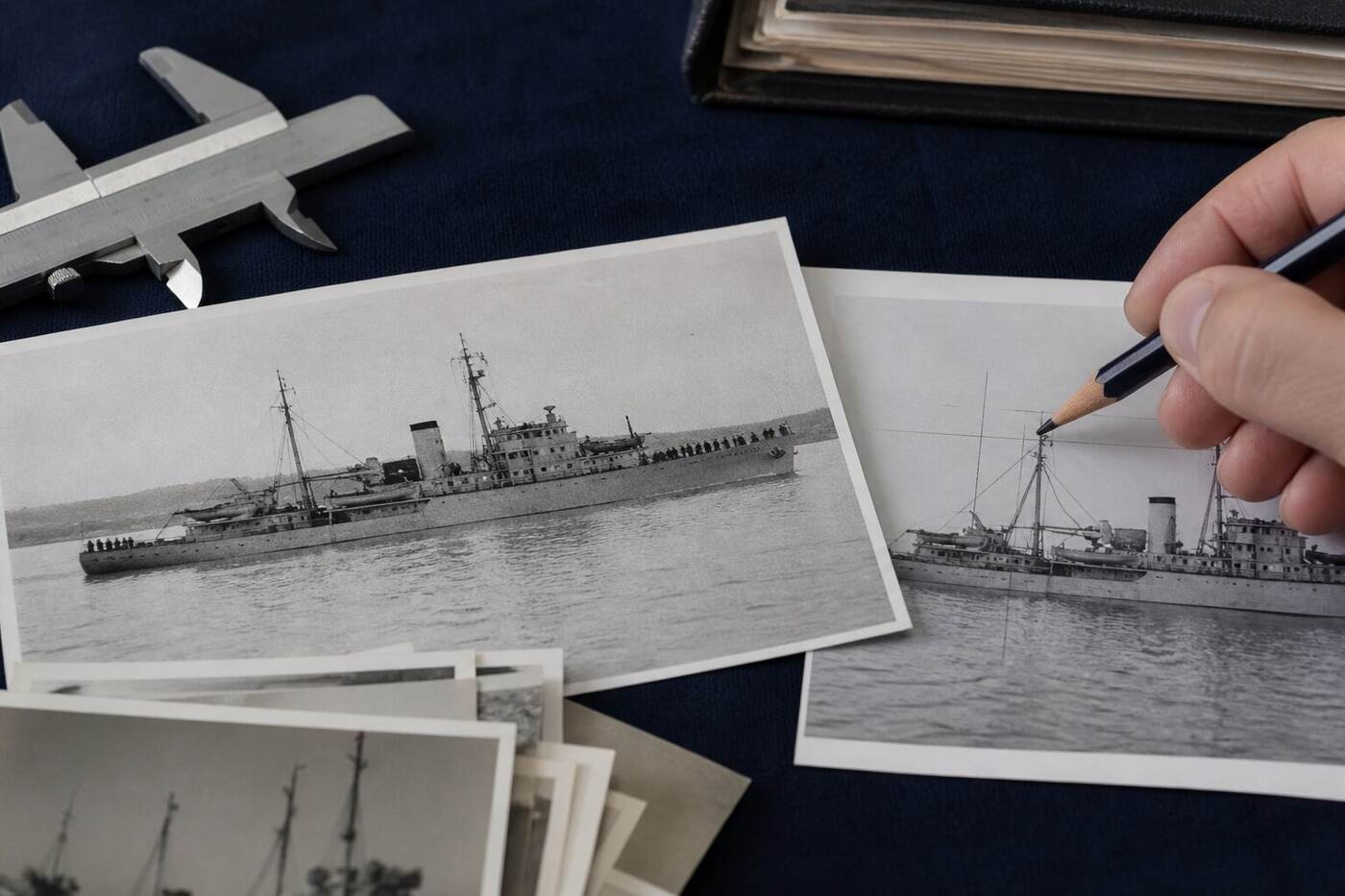
Begin with the whole frame
The most useful clue is often not a single fitting but the relationship between hull, superstructure, mast and working deck. Start by recording what is plainly visible, then compare it with dated official imagery or catalog descriptions. A likely resemblance is a lead, not a final identification.
Separate image evidence from caption evidence
A caption can carry a date, place or ship name, but captions travel and are sometimes copied. Keep the original caption, the repository record and the visual observation in separate notes. When they agree, confidence rises. When they do not, preserve the disagreement instead of smoothing it away.
Use a repeatable worksheet
Record the image source, catalog number, visible markings, estimated period, likely vessel type and unresolved questions. The same short worksheet works for a family scan, a museum image or a page preserved by the Internet Archive.
Fix the scale before reading details
The official dimensions provide a useful first check. A vessel believed to be Phoebe should make sense as a 144-foot coastal minesweeper with a 28-foot beam, not as a destroyer-sized hull or a small harbor launch. Relative proportions remain more dependable than an exact measurement taken from a print whose crop, lens and scan may distort perspective.
Next record the visible arrangement without naming it too quickly: bow profile, bridge position, mast, open working deck, rails, boats and any hull marking. A checklist prevents one attractive clue from dominating the identification. It also makes two researchers' notes comparable when the original photograph cannot be viewed together.
Use markings as dated evidence
A clear hull number is powerful, but even a number needs context. Paint can be obscured, a negative can be reversed and a caption can migrate from one copy to another. Preserve the exact scan, note whether the image was flipped and compare the character shapes with a dated reference before treating the marking as conclusive.
Quarterdeck name boards and other named artifacts offer another route, provided their catalog descriptions are kept with them. An object carrying the ship's name proves the identity of the object. Its photographed setting, date and custody still need separate support. This distinction is especially important when images circulate without repository metadata.
Build confidence in layers
A practical confidence note can use three levels. 'Observed' records what is visible in the pixels. 'Attributed' records what a caption, owner or catalog says. 'Corroborated' is reserved for cases where independent evidence agrees. The labels keep a plausible identification useful without making it sound stronger than the surviving material allows.
Period clues should be logged in the same way. Uniform details, neighboring vessels, pier equipment, shoreline and print stock may narrow a date range, but each has its own uncertainty. The strongest result is often a range with named reasons, not a single year selected because it fits the story a researcher hoped to tell.
Research worksheet
Put this method to work
For each candidate image, make a contact sheet that includes the uncropped scan, a detail of visible markings and a reference image with a known date. Write observations before reading other people's identifications, then compare. This order reduces confirmation bias and preserves clues another researcher can inspect. If the conclusion changes, retain the earlier attribution and its source in the history field. A corrected identification is more valuable when the archive can show why the first one seemed plausible and what new evidence changed it.
Continue the research
Follow the evidence into the next question
Confirm the ship's scale against the Phoebe profile before interpreting fittings.
Record ownership and caption history with the photo provenance guide so an attribution remains reviewable.
When people appear, the crew archive workflow adds privacy and permission checks.