Start with the designation
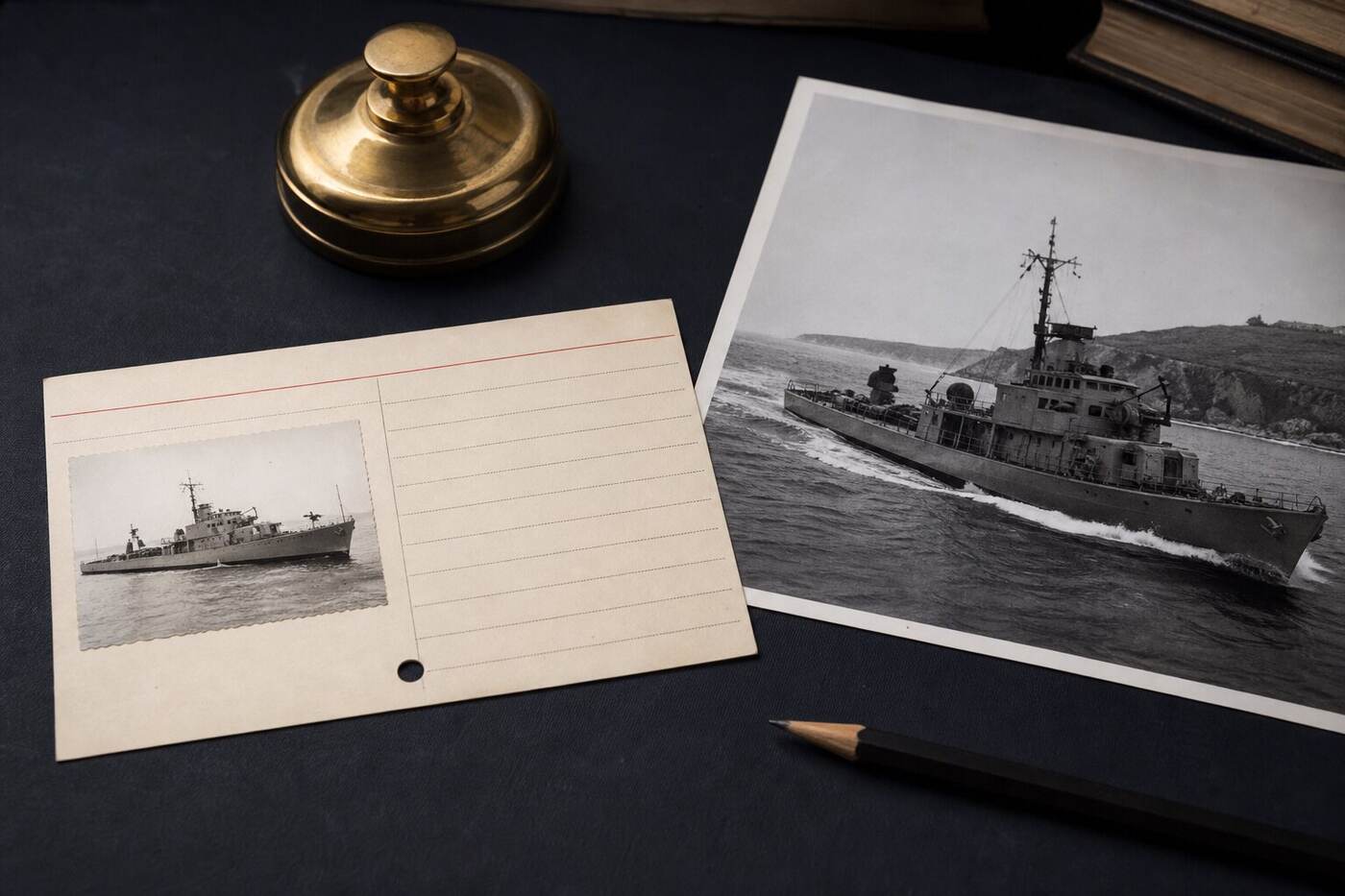
USS Phoebe appears in the record as a small coastal minesweeper whose identity is easiest to follow through its Navy designation, not through a loose collection of photographs. The DANFS entry provides the central line of orientation: construction, commissioning, assignments and later status belong together, while technical labels need to be read in the language of their own records.
Keep the ship and the memory distinct
The former site preserved a strong memory footprint around the ship, but an archive of pages is not the same thing as an official service history. This profile uses the archived route as a question generator and the Naval History and Heritage Command record as the factual spine. That distinction keeps a family photograph useful without asking it to prove a date.
A route into the ledger
From here, readers can move to the service chronology, the explanation of AMS and MSC designations, or the visual identification guide. Each route answers a different question and leaves uncertain details visible for later record work.
The official outline in dates
The Naval History and Heritage Command record begins before Phoebe entered service. Harbor Boat Building Company at Terminal Island laid the vessel down on February 26, 1953, and launched it on August 21, 1954. The Navy reclassified the ship as MSC-199 on February 7, 1955, before commissioning on April 29. Keeping those events in order prevents the launch date, classification date and commissioning date from being treated as interchangeable milestones.
The same record describes a compact ship: 320 tons displacement, 144 feet in length, a 28-foot beam, a 9-foot draft and a listed speed of 13 knots. Its complement is given as 39. Those numbers are useful for scale, but they should be read as an official summary rather than a complete plan of every fitting or later alteration.
From training ship to western Pacific service
Phoebe first served as a schoolship for prospective crews of Whippoorwill and Widgeon. On January 6, 1956, the ship became flagship of Mine Division 31 within Mine Squadron 3. It left Long Beach on March 4, reached Yokosuka on April 4 and shifted to Sasebo on April 10. Sasebo then became the durable geographic center of the story.
For the next eight years, the official history places Phoebe in minehunting and mine-warfare training with the Seventh Fleet. It also names exercises with Japanese, Chinese Nationalist, South Korean and Philippine naval forces. These references make the ship part of a regional system without requiring an invented day-by-day route.
What this profile can and cannot prove
A ship profile establishes identity, scale and a documented service outline. It does not identify every sailor in a photograph, reconstruct a watch bill or prove the location of an undated image. Those questions require deck logs, muster rolls, captions or personal collections with a recorded chain of custody. The profile is therefore the spine of the publication, not a substitute for its other records.
The surviving official summary follows Phoebe through Market Time patrols and late 1960s exercises, then leaves several administrative questions for other record series. A responsible account keeps that edge visible. It can say what the official history states while directing disposal questions to inactive-ship records and personal-history questions to archives designed to answer them.
Research worksheet
Put this method to work
A useful profile worksheet keeps five columns beside every statement: event, date precision, place, source and claim type. Construction, classification, commissioning, assignment and disposal are different claim types even when they appear in one chronology. This structure makes later corrections local. A newly found deck log can refine a movement without changing the ship's dimensions, while an inactive-ship record can refine disposition without being mistaken for the final operational log. The worksheet also exposes gaps honestly: no entry is filled from narrative momentum simply because the next date looks likely.
Continue the research
Follow the evidence into the next question
Place each milestone on the service timeline to see how date precision is recorded.
The change from AMS to MSC is unpacked in the designation guide, where the hull number becomes a practical search key.
For visual evidence, use the photo identification method before attaching a date or place to an image.
Return to the el dia de los libros history route.
Return to the blacksmith tools and fire route.
Return to the critique group practice route.