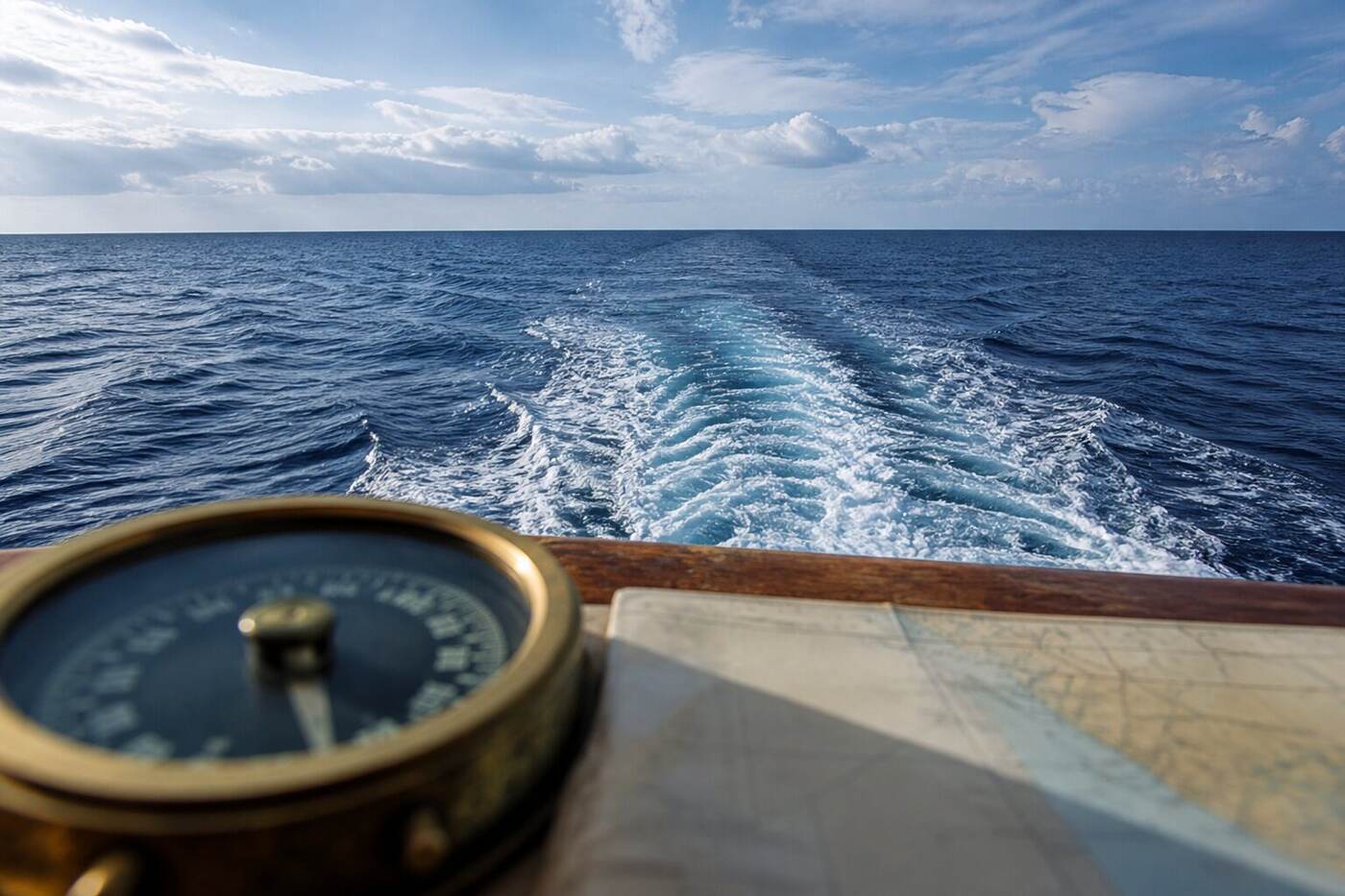
Route is an argument
A line on a map looks authoritative even when it is only an inference. A responsible route view starts with dated assignments and documented places, then labels every connection that remains interpretive.
Use the right granularity
A year-level assignment and a day-level movement are different kinds of evidence. The Service Ledger preserves that difference so a reader can understand where the record is firm and where a catalog search is still needed.
What would strengthen it
Deck logs, command reports and contemporaneous highlights can refine a route. Until those records are transcribed, the safest map is a sequence of supported settings rather than a smooth line that implies certainty.
Begin with named places and date precision
The official ship history names Japan, Taiwan, Korea, Okinawa and the Philippines among Phoebe's western Pacific settings. It also records a move into the South China Sea and waters off Vietnam in 1964, followed by later Market Time service. These are supported geographic anchors, but they do not all carry the same date precision.
A route table should therefore have separate columns for place, date or period, event type and source. 'During the next eight years' belongs in a period field. 'April 10, 1956' belongs in a day field. Keeping them apart prevents the map software, or the prose built from it, from implying a certainty the source never offered.
Do not let a line become evidence
Digital maps encourage a smooth path between known points. At sea, that line can hide days of movement, changes of course and unrecorded intermediate stops. The visible route should use points, bounded areas or dashed interpretive connections, with a legend that explains which geometry is documented and which is editorial.
Deck logs can strengthen the track because they are daily records, but even their formats have limits. NARA notes that latitude and longitude fields changed across the 1960s and were not always completed after the 1965 format revision. A blank coordinate field is not permission to interpolate a precise position from the next entry.
Make the route answer a question
One map might explain the transfer from Long Beach to Sasebo. Another might show the geographic reach of named exercises. A third might compare supported Market Time periods. Combining all three can create a crowded picture that looks authoritative but answers none of those questions clearly.
The publication keeps the Service Ledger as the factual index and uses route graphics as views of that data. When a new log entry is transcribed, the event record is updated first. The map is then regenerated from the corrected record, preserving a traceable relationship between evidence and visual explanation.
Research worksheet
Put this method to work
Before publishing a map, export its points as a table and ask whether every coordinate has a source and date. A place named only at country level should not receive a precise harbor pin. A month-level event should not be animated as a day-level voyage. Where the evidence supports only sequence, a textual itinerary may be more honest and more useful than a decorative line. The visual should make uncertainty legible, not hide it beneath polished cartography.
Continue the research
Follow the evidence into the next question
Anchor the route in the Sasebo home-port record.
Market Time locations need the scale controls in Phoebe's patrol history.
A coordinate should be checked through the deck-log workflow before it reaches a map.